
Questions
21438 North 7th Avenue
Phoenix, Arizona 85027
Phone: (623) 581-2648
Fax: (623) 581-0059
Visitors: 157572
|
ADDITIONAL FINISHES
|
|
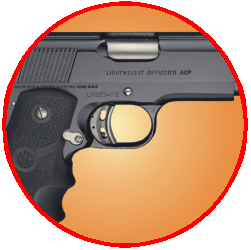
BLUEING The process of "Blueing" oxidizes metal surface to a corrosion-resistant, decorative finish. The black ("blue") finish is produced by a chemical reaction directly with the iron (Fe) in the steel to form the black oxide of iron (Fe3O4). Robar uses the latest chemicals containing new concepts in activators, catalysts, penetrants, inhibitors and rectifiers. The result is an attractive oxide-resistant finish on steel, including low and high carbon steels, alloy steels or hardened steels. Robar's process will not flake, chip, peel, or create any dimensional change. In using the latest technology in the "Blueing" process, Robar is able to create a more corrosion-resistant, abrasive-resistant, attractive deep black finish. Robar also guarantees that all specifications will meet or surpass all military, aeronautical and civilian specifications. Robar offers all of these benefits at cost-effective prices. This process restores your old firearm to a like new condition. Mil-C 13924-C, Class 1, Mil-Std-171(Ord) Finish 3.3.1. |
|||||||||||
| < Back to top > | ||||||||||||
|
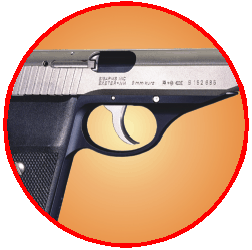
ELECTROLESS NICKEL Electroless nickel has become popular as a finish for firearms. Electroless nickel is economical, attractive and will give years of maintenance-free service. Robar confidently offers Electroless nickel for the following reasons: 1. Excellent resistances to fingerprints, "Sweat rust," petroleum distillates of all types, gun solvents, gun cleaners and all power residues. 2. A slat-spray corrosion resistance tolerance exceeding 1000 continuous hours per ml. thick deposit. 3. Plating rate is predictable, permitting a deposit of the exact desired thickness. 4. All surfaces are equally plated with micro-smooth nickel. This allows a natural low friction and lubricity resulting in smoother gun operation and reliability. 5. It rates 0.1 on the Taber Wear Index, making it tougher than hard chrome. This is significant in that Electroless Nickel provides a more wear resistant surface. 6. Expansion and contraction of the metal will not result in peeling of the nickel deposit. 7. Electroless Nickel will pass a 180 degree bend test, as specified under Mil-C-26074A, without peeling. 8. It is rated at Rockwell C53-56 in hardness before stoving (Rockwell 68-70 being possible). This means that plating of the wear surfaces alone will extend the useful life of a firearm. 9. Adhesion for this process is reported to be 30,000 to 60,000 pounds per square inch. 10. Electroless Nickel is durable and cost-effective. This eliminates further investments into finishing for the weapon. |
|||||||||||
| < Back to top > | ||||||||||||
|
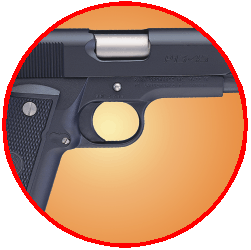
BLACKENING OF STAINLESS STEEL Robar is able to blacken stainless steel by using oxidizing type blacking compounds. This process produces black coatings on stainless steel and alloy steels by a "conversion" process. The chrome in the stainless steel is involved in a chemical reaction with the oxidizers in the solution producing chrome-sulphide. The application of the black finish is dependent upon the surface treatment of the steel. Bead blasted surfaces will have a satin black appearance while a surface blasted with aluminum oxide will be matte in nature. Importantly, dimensional changes involved in blackening are extreamly small, less than 0.0001 Mil. This thickness of the black oxide type coating ranges from 0.00006-0.0001 Mil depending on the type of alloy being treated. Blackening of stainless steel not only makes the weapon more attractive but adds to its corrosion resistance (96 hours salt spray per Mil-C-13924B) and aids in preventing galling, common in stanless steel guns. |
|||||||||||
| < Back to top > | ||||||||||||
|
PHOSPHATING/PARKERIZING Phosphating, better known as "parkerizing", is a process involving the transformation of the surface of the steel to a rust resistant manganese or zinc phosphate. Modern chemicals for phosphating are far superior to their predecessors. Phosphating is a non-reflective, matte black finish that resists corrosion and abrasion. The coating has a sponge-like structure that entraps oil or other corrosion resistant solutions producing an excellent coating for firearms exposed to high humidity and/or harsh environments. Phosphating will hide light scratches, pitting or blemishes. Coating thickness of the finish varies depending on the user requirement. Phophate coating applied by Robar will meet the following requirements: DOD-P-16232 F, Type M Class 1, 2 & 3 and Mil-P-50002 A Type 1, Composition B. DOD-P16232 F Type Z Class 1, 2 & 3. |
||||||||||||
|
||||||||||||